When imagining your future pool, the bench often appears as a simple step to enter the water. However, the width of this submerged seat radically changes the experience: if it’s too narrow, you barely sit on it; if it’s too wide, it eats into the swimming area. Choosing the right width for a pool bench involves balancing seating comfort, the aesthetics of the pool, and actual daily use.
Pool bench “water lounge”: a width designed for living in the pool
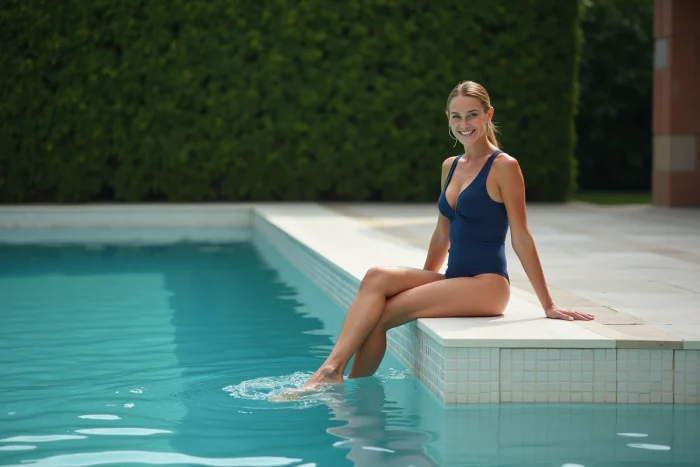
The most notable trend among pool builders in recent years is the bench designed as a true water lounge. We’re no longer talking about a simple ledge to rest your feet before swimming: we’re talking about a space where you can sit with a drink, where children play, and where you can read a magazine with your legs in the water.
Have you ever noticed that a living room sofa that is too shallow forces you to sit stiffly? The same principle applies underwater. A “water lounge” bench requires a width significantly greater than a simple access step. The goal is to be able to lean back, rest your elbows on the edge, or even partially lie down without sliding to the bottom.
Several pool design firms have noted a growing demand for benches that span the entire width of the short side of the pool, particularly in pools measuring 3 x 6 m or 3 x 7 m. This configuration replaces the traditional stairs and creates a true convivial “pool lounge,” oriented towards the garden or the view.
To understand the optimal width for a pool bench, you first need to identify the primary use you expect from it: passive relaxation, socializing, children’s play, or access to the pool.
Pool bench width according to use: concrete guidelines
Why talk about width rather than water depth? Because it’s the horizontal dimension of the seat that determines body posture. Water depth can then be adjusted based on the desired height (generally between 20 and 50 cm according to feedback from owners on specialized forums).
Here are the guidelines that emerge from technical catalogs and feedback from pool builders:
- Access or occasional rest bench: a modest seat width is sufficient. You sit there for a few minutes before swimming or to supervise children. This is the most common format in standard shell pools.
- Social bench (aperitif, reading): the width increases to allow you to lean your back against the wall and rest your arms on the edge. You should be able to sit comfortably for half an hour without feeling discomfort in your thighs or sliding.
- Multifunctional “water lounge” bench (children’s play, prolonged relaxation): the width is designed for two adults to sit side by side or for a child to lie down. Manufacturers like Desjoyaux or Génération Piscine offer in their recent catalogs multi-level benches (two seat depths plus an integrated access step) that vary the uses without increasing the total width.
The wider the bench, the more it reduces the swimming area. In a pool that is 3 meters wide, every centimeter counts. The trade-off is direct: you gain in seating comfort what you lose in length or usable surface for swimming.
Orientation and position of the bench in the pool
A detail that competitors rarely address: the orientation of the bench modifies the necessary width. Pool builders have reported a rise in requests for benches “facing the view,” positioned perpendicular to the swimming axis.
When sitting facing the landscape (garden, hedge, horizon), the body naturally turns. The width must then allow for easy rotation of the torso without hitting the opposite wall. This is a parameter often overlooked during sizing.
Conversely, a bench placed along the length of the pool (along one long side) can afford a narrower width, as the posture remains frontal. The choice depends on the terrain configuration and the placement of neighboring properties.

Bench on the short side or along the entire length
On the short side, the bench functions like the back of a sofa. People naturally gather there in groups. This is the most requested “pool lounge” configuration. The drawback: it shortens the pool, which can be a problem for those who want to swim.
On the long side, the bench serves more as an individual relaxation edge. It offers more linear seating length, but the width of each spot is often more restricted.
Bench width and technical constraints of the pool
Choosing the width does not happen in a vacuum. Several technical constraints frame the decision:
- Type of construction: a shell pool imposes predefined dimensions based on the manufacturer’s mold. The margin for customizing the width is limited. A concrete pool (masonry or sprayed) allows for custom sizing.
- Hydraulic circulation: the bench must not block the flow of water to the return jets or the skimmer. A competent pool builder checks that the chosen width does not create dead zones.
- Integrated equipment: massage jets, aerotherapy (bubbles), recessed LED lights. These options sometimes require a minimum width to house the equipment within the bench structure.
- Coating and finishing: a liner adapts to almost any shape, but tiling or mosaics requires adherence to dimensions compatible with tile formats to limit cuts.
In small pools, a multi-level bench compensates for a modest width by varying seat heights. This solution, increasingly present in the 2024-2025 catalogs, allows for a shallow children’s area and a more submerged adult area within the same footprint.
Design and landscape integration of the bench
The width of the bench directly influences the visual proportions of the pool. A very wide bench on a small pool gives the impression of a “wading pool.” A thin bench on a large pool goes unnoticed.
The visual balance is found when the bench represents a coherent volume relative to the total surface area. Pool builders often work with a visual ratio between the seating area and the swimming area, adapted to the desired style: minimalist, contemporary, Mediterranean.
The choice of furniture around the pool also plays a role. A garden chair placed at the edge visually extends the submerged bench. The aperitif table, wooden or stone surrounds, and vegetation all contribute to the impression of a unified relaxation space between the inside and outside of the water.
The ideal width of a pool bench does not exist in absolute terms. It depends on what you plan to do there, the size of your pool, and how your body fits into it. Before finalizing the dimensions, try to test a similar bench at a pool builder or in a showroom if possible. Real comfort cannot be guessed from a plan.