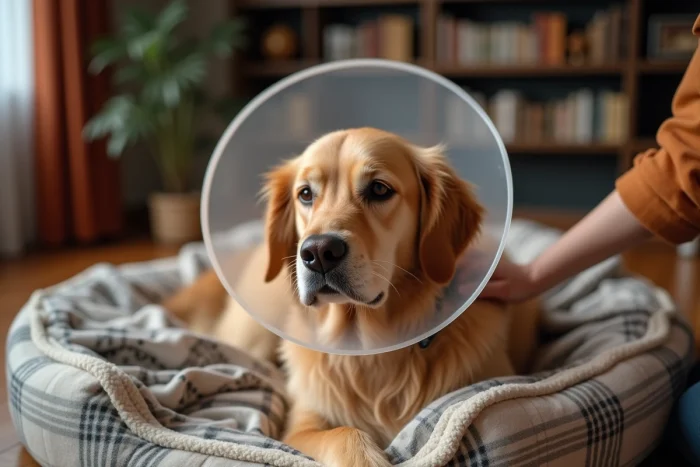
A dog wearing an Elizabethan collar after surgery or an injury alters its spatial references, eating habits, and interactions with its domestic environment. Protecting and reassuring a dog with a collar requires understanding what generates stress, then addressing each source of discomfort in a coordinated manner. This article analyzes the factors of disruption and compares approaches to limit anxiety throughout the recovery period.
Rigid, soft, or inflatable collar: comparison of impacts on dog behavior
The choice of collar type directly affects the level of stress and the dog’s ability to move, eat, and sleep. Each model presents trade-offs between wound protection and daily comfort.
| Type of collar | Wound protection | Peripheral vision | Feeding | Sleep | Risk of removal by the dog |
|---|---|---|---|---|---|
| Rigid plastic cone | Very good (entire body) | Reduced | Difficult (elevated bowl necessary) | Disturbed (rubbing, noises) | Low |
| Soft collar (fabric or foam) | Good (depending on muzzle length) | Better | Easier | Less disturbed | Moderate |
| Inflatable collar (ring type) | Limited (high body areas accessible) | Good | Nearly normal | Comfortable | High (deflation, puncturing) |
The rigid cone remains the veterinary reference because it prevents access to almost the entire body. However, it generates the most behavioral disruptions: bumping against furniture, difficulty drinking, inability to lie down in its usual position.
The inflatable collar offers better perceived comfort, but it does not protect wounds located on the legs or lower abdomen. A sufficiently flexible dog can maneuver around an inflatable collar to reach an abdominal incision, making it unsuitable after a spay, for example.
Before changing models on your own, it is essential to validate the choice with the veterinarian based on the exact location of the wound. Knowing the precautions for a dog with a collar also helps anticipate risks related to times when the dog is left alone.
Home recovery routine: the trio of environment, rest, and collar
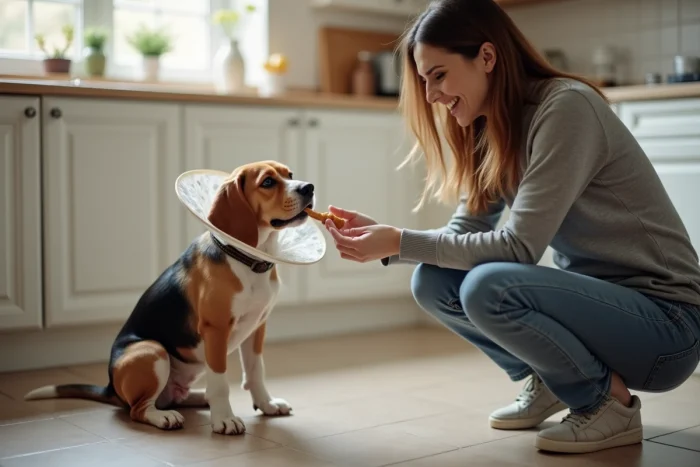
Competing articles treat the collar as an isolated object. Recent veterinary recovery guides emphasize a different point: the collar only works in an adapted environment. A dog stressed by its living conditions will be more likely to try to remove its collar, increasing the risk of wound infection.
Arranging the living space for the dog with a collar
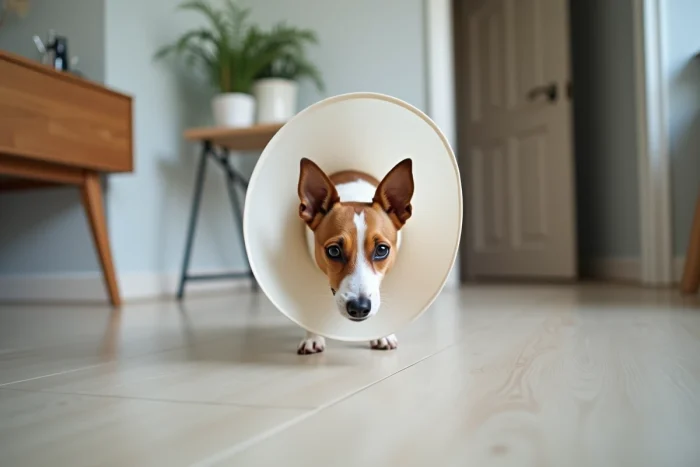
A dog with a rigid cone loses its distance references. It bumps into door frames, spills its bowl, and hesitates at stairs. Temporarily reducing its movement space decreases these incidents.
- Clear narrow passages (chairs, low tables, objects on the floor) so that the cone does not hit anything during movement
- Elevate water and food bowls, or use wider containers than the diameter of the cone so the dog can access them without blockage
- Place the bedding in a quiet corner, away from high-traffic areas, with a cushion wide enough for the dog to rest the edge of the cone comfortably
- Limit access to stairs and cluttered rooms during the entire duration of wearing the collar
Managing interactions with other animals and children
A dog wearing a collar is in a perceived vulnerable position. Interactions with other household animals can generate anxiety or even defensive reactions. Temporarily separating animals during the first hours allows the dog time to adapt to its new movement constraints.
Young children must be supervised. A sudden movement towards the cone can startle the dog, which cannot back away or turn its head normally.
Nocturnal stress and collar: why night is the critical time
Veterinarians observe that incidents of licking or removing the collar occur most often in the absence of the owner, especially at night. The dog, alone in the dark with a cumbersome object altering its sensations, may panic and make greater efforts to get rid of it.
Several strategies reduce this nocturnal stress without requiring constant supervision.
- Sleep in the same room as the dog during the first few days, while habituation takes place
- Move the dog’s bedding closer to the owner’s to provide comforting olfactory and auditory presence
- Leave a nightlight on: a dog disoriented by the cone in total darkness bumps into things more and becomes more agitated
- Use constant background noise (fan, soft music) to cover sounds amplified by the rigid cone, which acts as a resonator
This approach is based on a simple principle: reduce the association between the collar and isolation. A dog wearing its cone in a reassuring presence accepts it better than a dog wearing it alone in a closed room.
Collar and healing: the direct link between collar maintenance and infection prevention
Removing the collar “just for five minutes” because the dog seems unhappy is a frequent temptation. Veterinary sources specializing in surgery remind us that keeping the collar on until complete healing is one of the major measures to prevent incision infections.
Licking a surgical wound introduces oral bacteria to the surgical site. Just a few minutes are enough to compromise a healing process that was progressing normally. One unsupervised removal can lead to an infection requiring further treatment.
The duration of wear varies according to the procedure and the veterinarian’s advice. Shortening this duration without medical validation exposes the dog to longer and more uncomfortable complications than wearing the collar itself.
Warning signs to monitor under the collar
Check daily the skin under the edge of the cone, at the neck. An ill-fitting collar can cause friction irritations. If the dog refuses to eat for more than a few hours or shows signs of persistent lethargy, a call to the veterinarian is necessary to adjust the device or consider an alternative suitable for the location of the wound.
The protection of a dog under a collar relies less on the accessory itself than on the overall recovery framework. An adapted space, a reassuring presence at night, and strict maintenance of the collar until veterinary validation form the three pillars of a complication-free recovery.