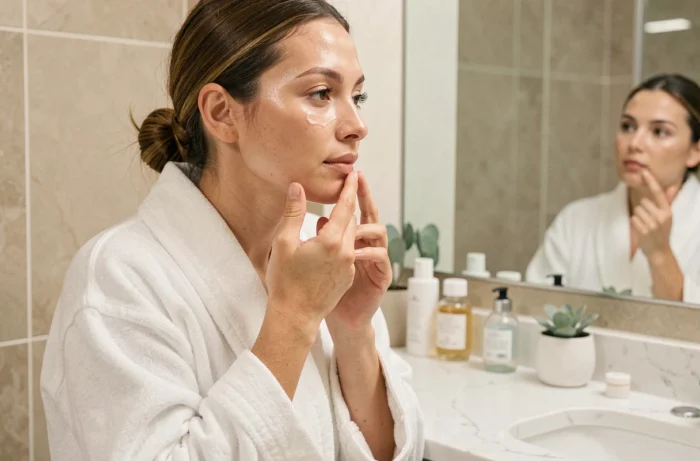
A bottle of serum that irritates instead of smoothing, a day cream reformulated without warning, a scrub too aggressive on already weakened skin: we all know that moment when the beauty routine produces the opposite effect of what was hoped for. Effective beauty advice starts from a simple observation: understand what the skin truly tolerates before piling on the products.
Cosmetic Labels and Allergens: What Your Beauty Routine Hides From You
We rarely start there, and that’s a mistake. Before choosing a facial treatment, turn the bottle around. Regulation (EU) 2023/1545 now requires stricter declarations of allergens in scented products.
For sensitive or reactive skin, the INCI list at the bottom of the packaging is not decorative. It helps identify substances likely to cause redness, tightness, or breakouts. Checking declared allergens before purchasing a product prevents many disappointments, especially when incorporating a new treatment into your routine.
You can easily find this information by consulting Espace Beauté’s beauty advice, which details the actions to take according to skin types and active ingredients to monitor.
In practice, if your day cream or serum contains more than ten listed fragrances or allergenic compounds, caution recommends a patch test on a small area of the wrist for two days. This simple reflex often suffices to spot an intolerance before it manifests on the face.
Retinol and Anti-Aging Treatments: New Regulatory Limits to Know
Retinol remains one of the most sought-after active ingredients for facial care, particularly for reducing signs of aging and imperfections. Regulation (EU) 2024/996 now regulates the maximum allowed concentrations of retinol in cosmetics, with different thresholds depending on the type of product (face or body).
If you use a retinol anti-aging serum or cream, check the concentration indicated on the packaging to ensure that the product complies with current regulations.
This restriction has pushed many brands to reformulate their products. Alternatives based on bakuchiol or peptides are now available, but feedback varies on this point: some skin types respond well, while others do less so. The most reliable approach remains to test a reformulated product for three to four weeks before judging its effectiveness.
Adjusting the Frequency of Retinol Use
Even at reduced concentration, retinol can irritate sensitive or dehydrated skin. It is recommended to start with an application every three nights, observing the skin’s reaction. If no redness or peeling appears after two weeks, you can switch to every other night.
Applying retinol on dry skin (never damp) and always following with a rich moisturizer reduces the risk of irritation. The next morning, sun protection becomes non-negotiable: retinol increases the skin’s photosensitivity.
Minimalist Facial Routine: Why Fewer Products Can Yield Better Results
Layering serum, essence, ampoule, cream, and oil seems logical when each product promises a different benefit. In reality, specialists now recommend simplicity in light of the persistence of concerning substances in certain cosmetics.
Reducing the number of products and favoring simple compositions better protects the skin barrier than an eight-step protocol. Each additional layer increases the risk of cross-reaction between actives, especially on acne-prone or reactive skin.
An effective daily facial routine can be summarized in three well-executed steps:
- A gentle cleanse morning and evening, with a product suited to your skin type (foaming gel for oily skin, milk or oil cleanser for dry skin)
- A single targeted treatment (hydrating serum, anti-blemish, or anti-aging treatment according to the main need)
- A moisturizer that locks in hydration and, in the morning, a sunscreen either integrated or applied on top
This foundation covers the majority of needs. A gentle scrub can be added once or twice a week to boost cell renewal without stressing the skin.

Facial and Body Scrubs: Common Mistakes
Mechanical scrubs (with grains) are suitable for normal to combination skin but can worsen imperfections on acne-prone skin. In this case, a chemical exfoliant based on gentle acids (lactic acid, mandelic acid) works on the surface without micro-lesions.
Never scrub irritated skin, sunburned skin, or skin experiencing an acne flare-up: this is the ground rule that prevents turning a beauty gesture into a factor of aggravation.
Daily Sun Protection: The Most Underestimated Facial Care
We often talk about it in summer, rarely the rest of the year. UV rays penetrate clouds and windows. Cumulative exposure accelerates skin aging much more than the lack of anti-aging serum.
Incorporating sunscreen into your morning routine year-round protects against pigmentation spots, loss of elasticity, and cellular damage. For the face, non-comedogenic formulas prevent the appearance of breakouts, a common complaint among those who abandon daily sun protection.
Some guidelines for choosing your protection:
- An index suited to your actual exposure (a daily commute does not require the same protection as a day outdoors)
- A texture compatible with makeup or treatments applied beforehand to avoid pilling
- A reapplication if exposure exceeds two consecutive hours outdoors
Sun protection remains the most documented anti-aging gesture by dermatological research. No serum can compensate for unprotected skin exposure.
Ultimately, an effective beauty routine relies less on the number of products than on their relevance. Reading labels, adhering to new regulatory constraints on actives, simplifying gestures, and protecting the skin from the sun daily: these four axes cover the essentials of what any skin expects, regardless of its type or age.