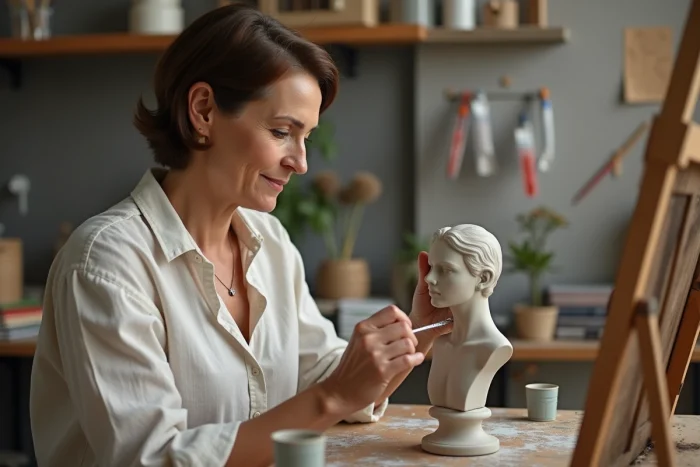
Painting a picture does not necessarily fall under the category of visual arts, while a comic book can be part of it. School programs distinguish these disciplines, but their boundary remains blurred in education as well as in popular culture.
Some prefer to speak of visual arts to encompass all practices, while others reserve the term “plastic arts” for very specific activities. These categories, although institutionalized, vary from country to country and from one era to another.
Plastic arts and applied arts: clear definitions for better understanding
To distinguish plastic arts from applied arts, one must go beyond the obvious. Plastic arts encompass a multitude of practices where the search for personal expression and emotion take precedence. Painting, sculpture, drawing, photography, engraving, digital art, video, performance, or installation: all these forms compose a universe where the artist is guided by gesture, experimentation, and subjectivity. Here, there are no strictly utilitarian rules, but a desire to explore matter, form, and meaning.
In contrast, applied arts respond to different requirements. Their domain consists of objects, spaces, and images designed to be used, carrying a functionality in addition to their aesthetic dimension. The designer shapes products, clothing, spaces, graphic identities, or communication media. Each project arises from a concrete need, an expected use, and a precise specification.
To better grasp these concepts, what is plastic art, the page Difference between art and plastic art: detailed explanations – Studavenir offers additional insight. This separation influences training, structures artistic education, and shapes professional trajectories, while contributing to the evolution of contemporary art.
Here, to clarify, are the main fields associated with each discipline:
- Plastic arts: painting, sculpture, drawing, photography, engraving, digital art, video, performance, installation.
- Applied arts: spatial design, fashion, product design, graphic design, communication, crafts.
In summary, the distinction lies in the purpose: personal expression versus responding to a use, creative freedom against functional constraint. This trait separates two ways of thinking and making art.
What are the differences and common points between these two artistic disciplines?
The artist in plastic arts enjoys the luxury of choice: themes, materials, techniques, everything is a field for experimentation. It is not about fulfilling an order or aiming for profitability. The center of gravity remains the exploration of form, matter, and emotion. Painting, sculpture, drawing, performance: each gesture translates a unique perspective on the world.
In contrast to this freedom, applied arts impose frameworks. Responding to a demand, integrating functionality, finding the balance between innovation and usability constraint: the designer, graphic designer, or object creator works at the intersection of creation and utility. They juggle the requirements of a client, industrial production, or a market, while maintaining a degree of inventiveness.
However, beyond these differences, a common ground emerges. In both fields, one finds:
- A creativity combined with technical mastery.
- A creation process made up of observation, experimentation, and analysis.
- The use of varied materials and knowledge of current techniques that permeate all artistic production.
On the training side, the paths often differ: art schools for some, design or applied arts schools for others. Careers also orient differently: museums, art market, teaching for plastic arts; companies, advertising, furniture, or interior architecture for applied arts. However, with the rise of digital technologies and new media, the lines are shifting. Disciplines intersect, boundaries blur, and collective experimentation gains ground.
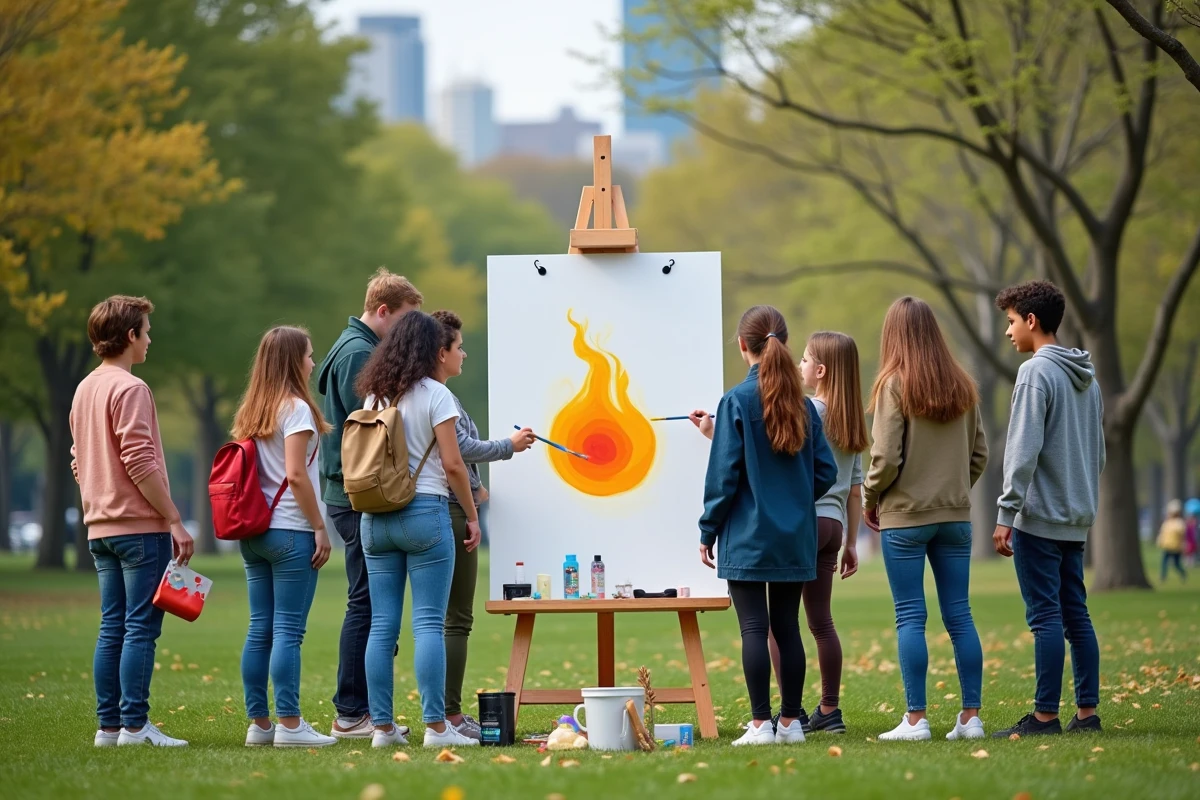
Going further: resources and avenues to deepen your discovery of art
The history of art spans millennia, from markings on walls to digital installations. To grasp the richness of approaches, nothing replaces direct confrontation with works and texts. Sociologist Nathalie Heinich, for example, offers a nuanced reading of the rejection of contemporary art and the evolution of perspectives on creation. Her approach, blending human sciences and reflection on art, helps to decipher the tensions between tradition and novelty.
In museums, during exhibitions or events, it is the visitor’s gaze that is forged, the critical mind that is built. An immersion in a higher art school, a DN MADE, or a DSAA allows one to touch upon the diversity of curricula, from DNA to DNSEP, from bachelor’s to doctorate. These programs provide tools to think and practice creation in all its forms, from painting to design, including sculpture and new media.
Digital tools, virtual or augmented reality, and artificial intelligence profoundly disrupt practices. Artists now design interactive installations where technology is an integral part of the experience, renewing our way of understanding materiality and perception.
Here are some concrete avenues to enrich your exploration:
- Consult reference books and specialized articles to broaden your vision.
- Analyze the paths of art critics, curators, educators, or cultural mediators.
- Participate in workshops or conferences to experience the diversity of methods and approaches.
Diving into the world of plastic arts and applied arts is to open the door to an infinite array of fertile intersections between practice, reflection, and technology. With each step, curiosity sharpens, analysis refines, and the creative horizon expands endlessly.