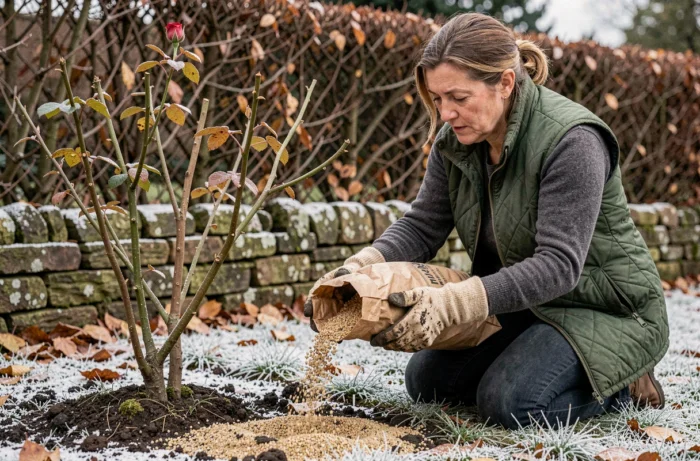
Your roses are losing their leaves, the vegetable garden is emptying, and you’re wondering whether to nourish the soil now or wait until spring. The answer depends less on the season than on what is growing in your garden and what you are actually adding to the soil. Choosing a winter fertilizer starts with understanding the difference between feeding an active plant and preparing the soil for the months to come.
Nitrogen in winter: the trap that weakens your plants
Have you ever noticed tender shoots on a shrub in the middle of December? This phenomenon often appears after a late nitrogen application. Nitrogen stimulates vegetative growth, which is desirable in spring.
In autumn or winter, these new shoots do not have time to lignify before the frost. The result: late nitrogen makes the stems vulnerable to the cold. The tips turn black, and the plant wastes energy repairing tissues it should not have produced.
What should you do then? Recent recommendations favor the application of mature compost or decomposed manure in autumn for established trees and shrubs. These amendments release their nutrients slowly, without causing a spike in nitrogen. Concentrated nitrogen applications should be reserved for spring when growth resumes in earnest.
To delve deeper into this seasonal fertilization logic, you can find all the articles on Envies de Jardin that detail the mixtures suitable for each period.
Fertilizer or winter amendment: two different logics
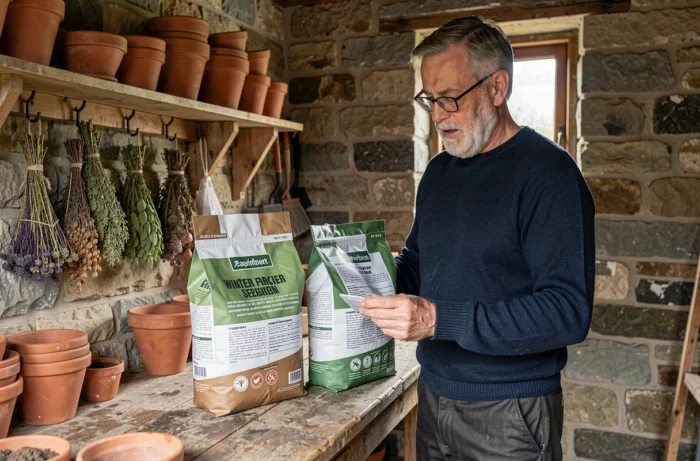
The confusion between fertilizer and amendment returns every autumn. A fertilizer provides nutrients that are directly assimilable by the plant (nitrogen, phosphorus, potassium). An amendment, on the other hand, improves the soil structure and nourishes the microbial life that composes it.
In winter, it is the amendment that works, not the fertilizer. Most plants are dormant. Their roots absorb very little. A soluble fertilizer spread in December remains in the substrate, and the unabsorbed salts accumulate around the roots.
Mature compost, well-decomposed manure, or organic mulch serve another function: they nourish earthworms, fungi, and bacteria that structure the soil throughout the winter. In spring, your plants find an aerated soil, rich in humus, ready to release its nutrients at the right time.
When a true fertilizer is justified in the cold season
Some specific cases warrant a winter nutrient application:
- Indoor plants placed under powerful and continuous artificial lighting, which continue to grow despite the season. A very diluted application of potassium and phosphorus supports their activity without excess.
- Early-flowering fruit trees (potted citrus, for example) that begin their cycle well before spring. A low-nitrogen but potassium-rich fertilizer strengthens their resistance.
- Crops under greenhouse or tunnel conditions, where temperature and light allow for actual nutrient absorption.
Outside of these situations, it is better to amend the soil than to fertilize dormant plants.
Green manures in winter: covering the vegetable garden soil
Leaving a vegetable garden bare during winter exposes the soil to erosion, nutrient leaching from rain, and compaction. Green manures offer a concrete alternative: these are plants sown not to be harvested, but to protect and enrich the soil.
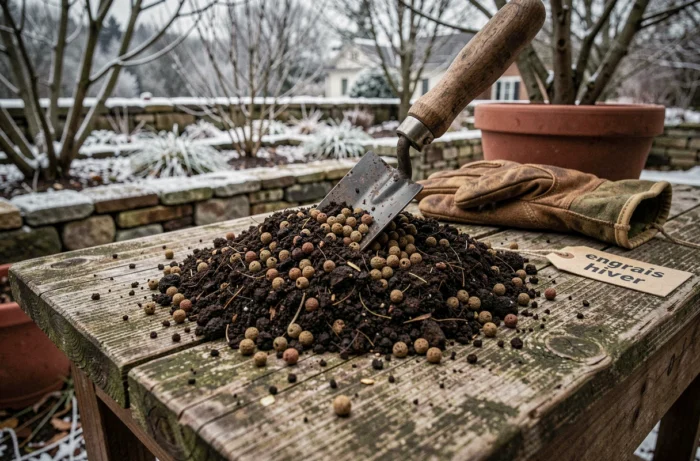
The choice of species mainly depends on the sowing date and local climate. Late sowing in November may fail in cold regions where the soil freezes at the surface. Mustard or phacelia are typically sown in September-October. Rye and vetch tolerate late sowing and harsh cold better.
What green manure truly brings to the soil
Legumes (clover, vetch) fix atmospheric nitrogen in the soil thanks to bacteria associated with their roots. Grasses (rye, oats) develop a dense root network that loosens the soil deeply.
In spring, you mow and incorporate this plant material into the top few centimeters of soil. It decomposes and gradually releases its nutrients, exactly when your vegetable crops will need them. It is a delayed, free fertilization that also improves soil structure.
Indoor plants in winter: the hidden risk of over-fertilization
Why do your indoor plants sometimes turn yellow in winter despite regular fertilization? The problem rarely comes from a deficiency. Winter over-fertilization causes a buildup of salts in the substrate, visible as whitish deposits on the surface of the potting soil.
When light decreases, root activity slows down. The nutrients provided are not absorbed. They remain concentrated around the roots, disrupting the water balance and can cause root burns. The leaf tips turn brown, a sign often confused with a lack of water.
The simple rule: fertilize only if you observe active growth. A new leaf unfolding on a Monstera in December justifies a light application. A ficus that hasn’t moved since October needs nothing, except for spaced watering and good lighting.
If you have over-fertilized, a thorough rinsing of the substrate (ample watering while allowing for good drainage) helps to flush out the accumulated salts before they damage the roots.

The best winter fertilizer is often not a fertilizer in the strict sense. For the outdoor garden, an organic amendment spread in autumn and a cover of green manures in the vegetable garden prepare the soil without risking weakening dormant plants. For indoors, restraint remains the best strategy: observe before feeding, and reserve applications for plants that show real signs of growth.