Contemporary photography refers to photographic practices that emerged from the 1980s, when the medium ceased to be a mere recording tool and claimed a status as a fully-fledged art form. This shift redistributed genres (portrait, landscape, documentary, staged) and opened the door to approaches where fiction, memory, and performance intertwine with reality.
Hybridization of mediums: when contemporary photography overflows the frame
The distinctive feature of recent contemporary photography lies less in the subject than in the way creators layer multiple disciplines within a single image. The hybridization of photography, painting, and staging redefines what a print can be.
Ethiopian photographer Aïda Muluneh illustrates this movement. Her highly constructed prints use bold color fields and symbolic compositions that borrow from both painting and visual performance. The result deliberately blurs the boundary between captured image and fabricated image.
This trend is particularly visible in contemporary African photography, which has long been absent from generalist panoramas focused on Europe and North America. Creators work on niklasson.net as well as in physical galleries, making these practices accessible to an audience that extends beyond the institutional circle.
Hybridization poses a concrete question for exhibition curators: where to classify a work that falls under portraiture, body painting, and set photography? Traditional categories (portrait, landscape, object, city) inherited from textbooks are no longer sufficient. Several festivals have responded by eliminating genre sections in favor of thematic pathways.
Photography awards and festivals: what recent distinctions reveal
Photography awards do not merely reward a portfolio. They direct the gaze of the public and collectors toward practices that the market would not have identified alone.
The Niépce Gens d’Images 2026 award was granted to Alexandra Catiere, a Belarusian photographer based in Paris. This distinction, one of the oldest in France, confirms that the French photographic scene includes creators from different geographical and artistic backgrounds.
On the side of young creation, the Rencontres de la Jeune Photographie Internationale de Niort brings together young photographers from various countries each year, invited to produce new series around themes related to living beings and contemporary transformations. This type of residency-festival plays a structuring role for artists who have not yet accessed major galleries.
Three elements distinguish a landmark award from a simple promotional showcase:
- The grant includes a production or residency, not just a sum of money, allowing the laureate to create a new series rather than show existing work
- The jury mixes image professionals (curators, editors) and outside perspectives (writers, filmmakers), avoiding the insularity of the photographic community
- The awarded series then circulate within a network of partner institutions, ensuring visibility beyond the award ceremony
A well-structured award acts as a career accelerator over several years, where a one-off exhibition quickly fades from memory.
Photographic creation process: from intention to print
Understanding contemporary photography requires going beyond the mere reading of the final image. The creation process – scouting, staging, post-production, choice of medium – is an integral part of the work.
Muriel Berthou Crestey, a doctor in aesthetics, conducted in-depth interviews with photographers to decipher their methods. Her book, published by Ides et Calendes, reveals that artists like Peter Lindbergh or Sarah Moon construct their images according to very different protocols, despite sometimes comparable visual results on the surface.
Some contemporary photographers work in long series, spread over several years, accumulating hundreds of shots before selecting a handful of prints. Others adopt an approach closer to performance: a single shot, a unique framing, without retouching. The choice between these two poles conditions the relationship to time, chance, and control that the artist maintains with their medium.
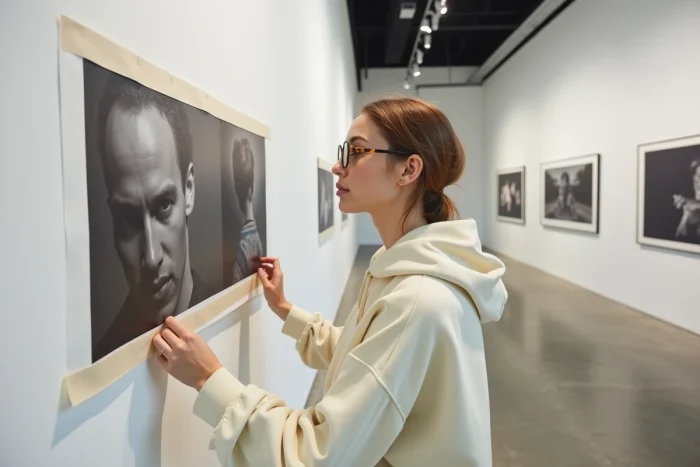
The question of the final medium has gained complexity. The same digital file can become an inkjet print on baryta paper, a wall projection, an artist’s book, or an immersive installation. Each destination modifies the reading of the image. An intimate small-format portrait does not have the same emotional impact when projected three meters high in a public space.
Visibility of women photographers in contemporary art
The place of women in contemporary photography has long reproduced the imbalances of the art world in general: underrepresentation in public collections, in major awards, and in monographs.
The program Elles font la culture, supported by the Ministry of Culture, lists and supports initiatives aimed at correcting this asymmetry. On the creation side, artists like Rineke Dijkstra, Sophie Calle, or Elina Brotherus occupy a central place in collections and reference works dedicated to contemporary photography.
Progress remains uneven across segments:
- In documentary photography and photojournalism, women remain a minority in historical agencies, although recent collectives are rebalancing the situation
- In artistic photography (staging, self-portrait, installation), women photographers are often at the origin of the most significant formal renewals in the past two decades
- In fashion photography, parity is progressing faster, driven by explicit demand from brands and magazines
Visibility is not limited to presence in exhibitions. Access to residencies, production grants, and institutional commissions determines an artist’s ability to develop long-term work. In this regard, dedicated programs are multiplying, but their real effect on careers remains difficult to measure in the short term.
Contemporary photography is defined less by a technique than by a stance: choosing what the image shows, what it hides, and the device in which it will be received. The creators who mark the current period are those who master this chain of decisions, from the shutter release to the gallery wall.