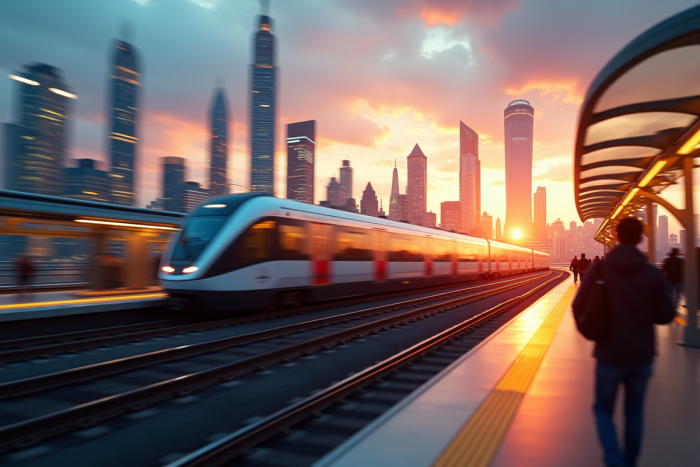
A train traveling at full speed does not save a second for the message you just sent. Yet, on the tracks, every moment stretches, every minute weighs heavily. The promise of high-speed trains fascinates as much as it divides. Between the muted calm of a still-sleeping station and the electric hustle of arrivals in the city center, the TGV inspires as many dreams as it does sighs.
As our journeys extend against a backdrop of climate concerns, the question looms: does high-speed rail truly deliver on its promises, or does it hold some unexpected detours? Beyond the advertised speed, modern travel reveals its own truths.
High-speed rail facing new mobility challenges
The ambitions of the high-speed train are at the heart of a revolution in European transport. As cities become denser and ecological urgency imposes its rules, rail is reinventing itself. The French network, led by SNCF, now connects Paris to Berlin, London, Amsterdam, Marseille, and Lyon. Speed and reliability are reshaping the map of our daily exchanges.
The French rail network, among the most extensive on the continent, evolves relentlessly to meet the growing appetite for greener mobility. Paris Gare du Nord, Paris Gare de Lyon: these stations are becoming true European hubs, capable of absorbing daily waves of passengers tired of flying. Now, booking a ticket can be done in just a few clicks on sncf connect — the line between improvisation and anticipation has never been so blurred.
- Main connections from Paris: Paris-London in 2h15, Paris-Brussels in 1h22, Paris-Lyon in under 2h.
- Technology: everything, from access control to booking, is moving into the digital age to smooth the traveler’s journey.
- Forward-looking vision: the futuristic Elon project, with its promises worthy of science fiction, stirs the debate on the future of ultra-fast transport.
The rise of the high-speed train raises questions about the network’s ability to integrate social and environmental dimensions. Behind the performance, issues of inclusion, impact on territories, and balance between efficiency and accessibility come to the forefront. Ultimately, the heart of the debate lies in how speed, space, and society intertwine on these steel tracks. To delve deeper, an in-depth analysis of high-speed rail sheds light on what this mode of transport truly entails.

Traveling at high speed: what real benefits for users and the planet?
The high-speed journey transforms our relationship with territory. Crossing France or Europe in the blink of an eye changes habits, brings metropolitan areas closer, and maximizes time. Passengers enjoy onboard services: wifi, charging ports, a bar car, accessible toilets equipped with changing tables. This rise in quality accompanies a diverse offering, from the most affordable seat to the most plush first class.
- Night trains are making a comeback for long journeys. A Paris-Stockholm or a Stockholm-Narvik: sleeping on the move, waking up in a new setting, sometimes marked as a UNESCO World Heritage site.
- Flexibility becomes tangible: online booking, attractive fares based on time, age, or advance booking.
The environmental advantage of high-speed trains is no longer just a slogan, supported by Ademe figures: one ton of freight transported by rail emits up to nine times less greenhouse gases than by road. The rise of rail freight, boosted by combined transport, reduces pressure on roads, alleviates congestion in cities, and preserves infrastructure. For the traveler, the carbon footprint of a TGV journey remains far below that of flying over the same distance.
With its speed and adaptability, high-speed rail is gradually establishing itself as a major player in contemporary mobility. A strong link in the ecological transition, it moves, discreet or loud, between today’s challenges and tomorrow’s horizons.