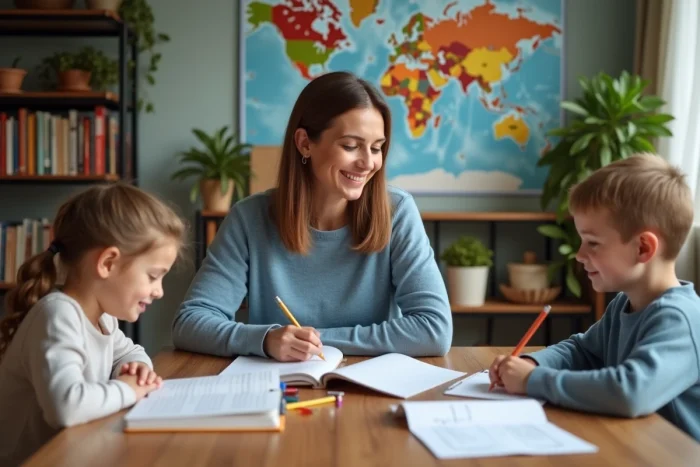
Renewing one’s freedom every year: that’s the price to pay for choosing homeschooling in France. Far from being a mere formality, the annual declaration commits each parent to ensure a progression comparable to that of school, while maintaining control over teaching methods.
The oversight from the Ministry of Education comes down like a guillotine: an inspection that does not forgive approximations and can impose a return to school. Yet, the arsenal of tools and networks available is reassuring: with method and support, it is possible to offer an educational path that respects the rules… and the children.
Homeschooling: what the law says and what it implies on a daily basis
Homeschooling is no longer just a simple notification to the administration: since the law of August 24, 2021, every project must obtain the approval of the DASEN. This means creating a solid file, presenting a well-argued educational project, and justifying the child’s situation. This legal framework has changed the game. Now, each parent plays the role of conductor, managing the program, organization, and responsibility for monitoring.
The commitment? It leaves no room for approximation. The educational control conducted each year by the academy checks that the child’s progression aligns with the common core. Every two years, the town hall investigates the material conditions and family dynamics. At the slightest failure, the sanction falls: mandatory school enrollment. Anticipating expectations, structuring learning, and documenting the journey have become essential to stay on track.
For those who wish to delve deeper into these processes, understand the administrative subtleties, and learn about the resources available, it is possible to find out more about Home Educ.
Getting started with homeschooling: what steps and essential questions before beginning?
This choice raises much more than just school organization: it alters the balance of daily life as a whole. Committing to homeschooling requires deep reflection on one’s motivations, as well as great rigor from the outset in preparing the file: Cerfa form 16212, detailed educational project, proof of a recognized reason (health, disability, distance, or a particular commitment of the child, for example).
This project is not a mere formality: it will be necessary to precisely describe who teaches (parents, qualified teachers, distance learning) and how learning is planned throughout the year. Nothing is improvised. Each element must demonstrate the child’s progression in relation to the common core. Physical and moral safety, as well as the educational environment, are examined during inspections. Some parents enlist the help of an educational advisor, while others rely on an organization that aligns with school cycles to ensure nothing is overlooked.
Over the years, the strength of the file, the coherence of pedagogical choices, and the ability to anticipate administrative expectations make the difference in obtaining or renewing approval. But the impact goes beyond the academic realm: increased autonomy for children, disrupted life rhythms, and complete family reorganization are common for all who take the plunge.

Essential resources for starting homeschooling on the right foot
To start homeschooling on solid foundations, it is important to select resources that fit the family project. Several types of tools can structure daily life:
- Textbooks: they allow for precise following of the program, step by step, and facilitate preparation for the annual educational control.
- Alternative pedagogies (Montessori, Freinet, Charlotte Mason): these methods prioritize autonomy, hands-on experience, and experimentation, to give meaning to learning and respect each child’s pace.
Alongside traditional materials, digital resources hold a prominent place. Educational apps, support platforms (like eduscol or canopé), podcasts, books, free or paid educational games, documentaries: the list of resources grows each year. These tools diversify the way of learning, whether it’s reviewing basics in mathematics, deciphering sciences, or exploring the world through history or geography.
Beyond materials, the strength of the collective: homeschooling associations, local groups, family workshops, educational outings, and resource sharing. These networks energize learning, break isolation, and allow for sharing experiences and good tips. Financially, it is also wise to turn to the CAF to learn about the conditions for accessing the back-to-school allowance, often unknown, which eases the budget for supplies or textbooks.
Choosing homeschooling means accepting to redefine what learning means, day after day. At the end of the journey, education is reinvented, outside the beaten paths, between the reassuring walls of a home and the open horizons of digital resources. The future of school could well be played out there, in these individual choices with collective resonances.