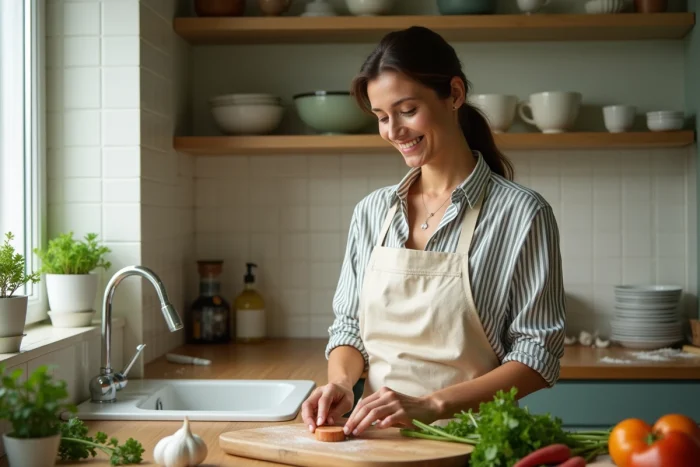
Opening the fridge at 7 PM with the feeling of starting from scratch is often where the stress begins. The main difficulty of cooking at home every day doesn’t come from a lack of easy recipes, but from everything that precedes the pot: deciding what to eat, checking what’s left, anticipating the week. A few concrete adjustments in planning and ingredient choices can radically change the experience.
Mental load of meals: the real barrier to home cooking
Have you ever noticed that the most exhausting part isn’t chopping vegetables, but answering the same question every day: “What are we having for dinner?” According to the Cetelem Observatory, the mental load related to planning and shopping is now the main difficulty for households that cook at home. The list, the budget, the anticipation weigh more than the preparation itself.
To reduce this pressure, one principle works: separate the moment of decision from the moment of cooking. Taking ten minutes on Sunday to jot down five meal ideas on a piece of paper is enough. No need for a detailed menu down to the gram, just a direction for each evening.
The natural reflex that follows is to make a grouped shopping list. Buy all the ingredients for several easy recipes for the week at once, and save trips to the supermarket. Tools like those found on easy-cooking.fr help structure this step without spending an hour on it.

Easy everyday recipes: focus on a base of versatile ingredients
Instead of piling up different recipes each week, build a small repertoire around about ten ingredients that you buy systematically. Why this choice? Because the same product can be used in three distinct dishes without giving the impression of eating the same thing.
All-purpose vegetables and starches
Onions, carrots, potatoes, and zucchini can be made into soup, gratin, stir-fry, or roasted as a side dish. Add rice and pasta, and you cover most of your weekday meals.
The same vegetable cooked differently completely changes its flavor. Sautéed zucchini with garlic is nothing like roasted zucchini with grated cheese. It’s this variation in cooking, not the multiplication of ingredients, that avoids monotony.
Basic proteins and condiments
Always keep eggs, chicken, and a can of legumes (lentils, chickpeas) on hand. For condiments, mustard, tomato paste, soy sauce, and lemon can transform a bland dish into a tasty one in seconds.
- Eggs: stuffed omelet, fried eggs on vegetables, quick crustless quiche. Five minutes of cooking, zero waste.
- Chicken: sliced in a wok, whole roasted on Sunday for two meals, shredded in a salad the next day.
- Lentils or chickpeas: base for a thick soup, quick curry, or a composed salad with cheese and raw vegetables.
With this base, you never need more than eight fresh products per week to cook at home every evening.
Safe batch cooking: cooking in advance without food risks
Preparing meals in advance is the most recommended reflex for cooking without stress. However, ANSES pointed out in 2023 that poorly managed batch cooking generates new hygiene risks: too slow cooling, too long storage, insufficient reheating.
Specifically, when you cook a large stew on Sunday, don’t let it cool for two hours on the countertop. Divide it into shallow containers to speed up cooling, then place it in the refrigerator within an hour.
Storage durations to respect
A homemade dish can be stored in the refrigerator for a maximum of two to three days. Beyond that, freezing takes over. Label your containers with the preparation date to avoid guessing on Thursday evening.
Reheating is as important as storage. A dish must reach a sufficient internal temperature, not just warm up in the microwave. For soups and sauces, bring to a boil. For gratins, bake them in the oven rather than using the microwave: the result will be better in taste and safety.

Cooking during the week without stress: three typical meals in under twenty minutes
Theory is good, but a concrete example is worth more than a long speech. Here are three meals that require neither special technique nor rare ingredients.
Stir-fried rice-vegetables-egg: sauté leftover cooked rice with sliced vegetables (zucchini, bell pepper, onion). Crack an egg on top, mix, add a splash of soy sauce. Ready in twelve minutes.
Quick pasta gratin: mix cooked pasta with diluted tomato paste and a bit of cream, add grated cheese. Bake for fifteen minutes. In the meantime, prepare a green salad.
The blended soup for dinner: cook carrots and potatoes in broth. Blend, add a spoonful of cream or fresh cheese. With a slice of bread, it’s a complete meal that only takes the cooking time of the vegetables.
These three dishes use the same base ingredients. That’s the whole point of a versatile base: fewer shopping trips, less waste, more perceived variety.
Cooking at home every day requires neither culinary talent nor special equipment. What makes the difference is grouping food decisions into one time slot per week and keeping a stock of simple ingredients that combine with each other. The weekly menu doesn’t need to be perfect, just sufficient so that the fridge is no longer a source of anxiety at 7 PM.